
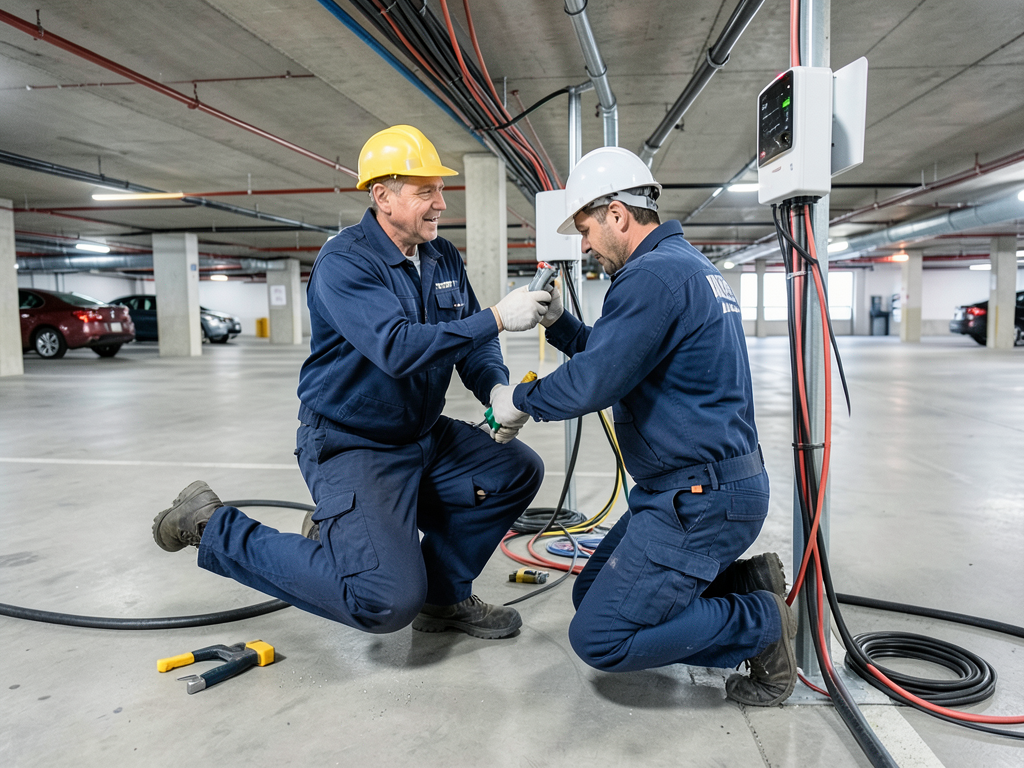
Installing Level 2 EV Chargers for Your Century City Commercial Parking Garage
Commercial property owners in Century City face a clear choice in 2026. Electric vehicles are no longer a niche market. They are becoming the standard for employees, tenants, and visitors. Without charging infrastructure, your parking garage risks becoming a liability instead of an asset.
Installing Level 2 EV chargers in your Century City commercial parking garage requires more than just mounting hardware. You need to navigate LADBS permitting, understand LADWP rebate programs, and ensure your electrical system can handle the additional load. Property managers who delay face higher installation costs and lost revenue from tenants who demand charging access. LADWP Charge Up LA program.
Century City’s dense office towers and luxury residential buildings create unique electrical challenges. The area’s aging infrastructure means many garages need electrical system upgrades before any charging equipment can be installed. Load calculations must account for peak usage during business hours when multiple vehicles charge simultaneously.
Level 2 chargers deliver 240 volts and charge most EVs in 4-8 hours. This speed works perfectly for office workers who park all day or residents who charge overnight. Unlike DC fast chargers that require 480-volt service and cost significantly more, Level 2 stations provide the right balance of speed and affordability for commercial parking applications.
Understanding the Commercial EV Charging Landscape in Los Angeles
The California Air Resources Board has mandated that all new passenger vehicles sold in California must be zero-emission by 2035. This regulation creates immediate pressure on commercial property owners to install charging infrastructure. Century City businesses that wait until the last minute will face contractor shortages and premium pricing.
Los Angeles Department of Water and Power offers substantial rebates through their Charge Up LA program. Commercial properties can receive up to $4,000 per charging port for Level 2 installations. These rebates significantly reduce the upfront capital expenditure and improve project ROI.
Southern California Edison’s Charge Ready program provides additional incentives for commercial installations. The program covers up to 80% of equipment costs for qualifying businesses. Property owners in SCE territory can stack these rebates with LADWP incentives when applicable. Southern California Edison Charge Ready.
EVITP certified electricians understand the specific requirements for commercial charging installations. These technicians complete specialized training in EV infrastructure and stay current with evolving standards. Hiring certified professionals ensures your installation meets all safety codes and qualifies for available rebates.
Commercial EV Charger Installation: What Property Managers Need to Know
Commercial EV charger installation differs significantly from residential projects. Your Century City parking garage likely requires extensive electrical infrastructure upgrades. The existing electrical panels may need replacement to handle the additional load from multiple charging stations.
Load management systems become critical when installing multiple charging ports. These systems prevent electrical overloads by intelligently distributing power among charging vehicles. Without load management, simultaneous charging could trip breakers or create fire hazards. Installing a backup generator for your Hollywood Hills home before the next outage.
ADA compliance requirements affect charger placement in commercial settings. Title 24 mandates specific clearances and accessible parking space requirements. EV charging stations must be positioned to accommodate wheelchair users and meet all accessibility standards.
Network connectivity enables modern charging stations to track usage, process payments, and provide real-time status updates. Commercial installations typically include cellular or Wi-Fi connectivity for station management. This connectivity allows property managers to monitor energy consumption and generate revenue from charging fees.
Step-by-Step Commercial EV Charger Installation Process
The installation process begins with a comprehensive site assessment. Electricians evaluate your existing electrical infrastructure, determine optimal charger locations, and calculate total electrical load requirements. This assessment identifies potential challenges before work begins.
Permit acquisition through LADBS represents a critical step. Commercial EV installations require electrical permits, building permits, and sometimes structural permits if mounting involves concrete work. The permitting process typically takes 2-4 weeks depending on LADBS workload.
Electrical infrastructure upgrades often precede charger installation. This may include replacing main electrical panels, installing new conduit systems, or upgrading service entrance equipment. These upgrades ensure your garage can safely support multiple charging stations. Upgrading your Beverly Hills estate to a 400 amp electrical service.
Hardware installation follows infrastructure preparation. Professional electricians mount charging stations, run conduit and wiring, and establish network connections. The installation team coordinates with your property management to minimize disruption to garage operations. Safely Wiring Your New Pool or Hot Tub in Encino.
Final inspection and commissioning complete the process. LADBS inspectors verify code compliance, and electricians test all charging equipment. The system becomes operational only after passing all inspections and safety checks.
Cost Factors for Commercial EV Charging Installation
Several factors influence commercial EV charging installation costs. Electrical infrastructure upgrades often represent the largest expense. Older garages may need complete electrical system replacements to support modern charging equipment.
The number of charging ports affects both equipment and installation costs. Installing multiple ports simultaneously reduces per-port installation costs through economies of scale. Property managers should consider future demand when determining the initial installation scope.
Site conditions impact installation complexity and cost. Underground parking requires different installation approaches than surface lots. Concrete coring, trenching, and conduit routing all affect project timelines and budgets.
Network and payment systems add ongoing operational costs. Subscription fees for charging management software typically range from $15-30 per month per station. These systems enable revenue generation and usage tracking.
Rebates and Incentives Available for Century City Businesses
LADWP’s Charge Up LA program offers substantial rebates for commercial properties. Level 2 charging stations qualify for up to $4,000 per port. The program requires pre-approval before installation begins and mandates the use of qualified contractors.
Southern California Edison’s Charge Ready program provides additional incentives. Commercial customers can receive up to 80% of equipment costs covered. The program targets workplaces, multi-unit dwellings, and fleet facilities. Is Your Sherman Oaks Home Ready for a 200 Amp Panel Upgrade?.
CALeVIP (California Electric Vehicle Infrastructure Project) offers regional incentives through partnerships with local utilities. These rebates vary by location and installation type. Century City businesses should check current CALeVIP offerings when planning installations.
Federal tax credits remain available for commercial EV charging infrastructure. The Alternative Fuel Vehicle Refueling Property Credit provides up to 30% of qualified expenditures. These credits can be claimed on federal tax returns for the installation year.
Maintenance and Service Level Agreements for Commercial Charging
Commercial charging stations require ongoing maintenance to ensure reliability. Network connectivity issues, software updates, and hardware failures can render stations unusable. Property managers need service level agreements (SLAs) that guarantee response times.
Preventive maintenance extends equipment life and prevents costly downtime. Regular inspections identify loose connections, worn components, and software issues before they cause failures. Maintenance contracts typically include quarterly inspections and priority service.
Emergency repair services become critical when charging stations fail. Commercial properties cannot afford extended downtime when tenants or customers cannot charge their vehicles. SLA agreements should specify maximum response times for emergency repairs. Finding an Emergency Electrician in Silver Lake Who Actually Answers the Phone.
Software updates keep charging stations current with evolving EV standards. Manufacturers release firmware updates to improve compatibility, security, and functionality. Professional maintenance includes keeping all charging station software current.
Commercial EV Charging Hardware Options
ChargePoint offers comprehensive commercial charging solutions with extensive network management capabilities. Their stations support multiple power levels and include robust payment processing. ChargePoint’s commercial focus makes them ideal for workplace and multi-unit applications.
Tesla provides commercial charging equipment compatible with all EV makes. Their Wall Connector offers reliable performance and integrates with Tesla’s charging network. Tesla’s commercial products include fleet management capabilities for businesses with multiple EVs.
Wallbox manufactures sleek, high-performance charging stations suitable for commercial environments. Their stations offer advanced features like dynamic load management and solar integration. Wallbox’s design aesthetic appeals to luxury properties in Century City.
JuiceBox provides cost-effective commercial charging solutions with smart features. Their stations include energy monitoring, scheduling capabilities, and mobile app control. JuiceBox offers excellent value for properties seeking basic charging functionality.
Commercial EV Charging ROI and Payback Analysis
Commercial EV charging installations typically achieve payback through multiple revenue streams. Charging fees generate direct income from users. Many properties charge $0.30-0.50 per kWh, creating steady revenue that offsets installation costs.
Property value increases represent another ROI component. Buildings with charging infrastructure command higher rents and sale prices. Studies show properties with EV charging see 2-5% higher occupancy rates and rental premiums.
Employee satisfaction and retention improve with workplace charging access. Companies offering charging as an amenity report better recruitment outcomes and higher employee satisfaction scores. These benefits translate to reduced turnover costs.
Energy cost management through smart charging reduces operational expenses. Time-of-use rate optimization and solar integration can significantly lower electricity costs for charging operations. Advanced systems automatically charge during off-peak hours.
Case Studies: Successful Commercial EV Charging Installations
A Century City office tower recently installed 20 Level 2 charging stations across three parking levels. The project required electrical panel upgrades and new conduit systems. The property now generates $3,000 monthly in charging revenue while improving tenant satisfaction.
A luxury apartment complex in adjacent Beverly Hills added 15 charging stations to their garage. The installation included load management systems to prevent electrical overloads. Residents report the charging amenity as a key factor in lease renewals.
A corporate campus in Santa Monica implemented a comprehensive EV charging strategy with 50 Level 2 stations. The system includes solar integration and battery storage. The company achieved 100% employee EV adoption and reduced transportation-related emissions.
Frequently Asked Questions
How long does commercial EV charger installation take?
Most commercial installations require 4-8 weeks from initial assessment to final commissioning. This timeline includes permitting, electrical upgrades, and installation work. Complex projects with extensive infrastructure upgrades may require 12+ weeks.
What permits are required for commercial EV charging?
Commercial EV installations require electrical permits from LADBS and often building permits. Some projects need structural permits if mounting involves concrete work. Fire department permits may be required for certain installation types.
Can existing electrical panels support EV charging?
Many older electrical systems cannot support EV charging loads. Properties built before 2000 often need panel upgrades or service entrance improvements. A professional load calculation determines if your existing infrastructure is adequate.
What rebates are available for commercial EV charging?
LADWP offers up to $4,000 per port through Charge Up LA. SCE provides up to 80% equipment coverage through Charge Ready. Federal tax credits cover up to 30% of qualified expenditures. Multiple rebates can often be combined.
How much does commercial EV charging installation cost?
Installation costs vary widely based on electrical requirements and site conditions. Simple installations start around $3,000 per port. Complex projects requiring infrastructure upgrades can exceed $10,000 per port.
Making the Right Choice for Your Century City Property
Commercial EV charging installation represents a significant investment that delivers multiple returns. Property managers who act now benefit from available rebates, contractor availability, and growing tenant demand. Those who delay face higher costs and competitive disadvantages.
The right installation partner makes all the difference. EVITP certified electricians understand commercial requirements, navigate permitting processes efficiently, and ensure code compliance. Professional installation protects your investment and ensures reliable operation.
Century City’s position as a commercial hub makes EV charging infrastructure essential for property competitiveness. Office tenants, residents, and visitors increasingly expect charging access. Properties without this amenity risk losing tenants to better-equipped competitors.
Load calculations, infrastructure assessments, and rebate applications require professional expertise. Attempting DIY installations or hiring unqualified contractors often results in code violations, failed inspections, and lost rebate opportunities.
Commercial EV charging installation success depends on proper planning, professional execution, and ongoing maintenance. Property managers should view this as a long-term investment in property value and tenant satisfaction rather than a simple equipment purchase.
Next Steps for Century City Property Owners
Commercial EV charging installation requires careful planning and professional execution. Property managers should begin with a comprehensive site assessment to understand their specific requirements and constraints.
Permit acquisition through LADBS represents a critical path item. Starting the permitting process early prevents project delays and ensures timely completion. Professional electricians familiar with local requirements can navigate this process efficiently.
Rebate applications require careful documentation and timing. Many programs have limited funding and specific eligibility requirements. Working with experienced contractors ensures maximum rebate capture and proper documentation.
Property owners should consider future expansion when planning initial installations. Installing conduit and electrical capacity for future stations reduces costs for later expansion. Planning for growth prevents expensive retrofit work later.
Commercial EV charging installation in Century City requires professional expertise and careful planning. Property managers who invest in quality installation now will benefit from tenant satisfaction, revenue generation, and property value appreciation for years to come.
- Site Assessment
Professional electricians evaluate electrical infrastructure, determine optimal locations, and calculate load requirements. This identifies potential challenges before work begins.
- Permit Acquisition
Submit LADBS permit applications for electrical and building permits. This process typically takes 2-4 weeks depending on workload and project complexity.
- Infrastructure Preparation
Complete necessary electrical upgrades including panel replacements, conduit installation, and service entrance improvements. This ensures safe operation of charging equipment.
- Hardware Installation
Mount charging stations, run wiring and conduit, establish network connectivity. Coordinate with property management to minimize disruption to operations.
- Final Inspection
Schedule LADBS inspection to verify code compliance. Electricians test all equipment and ensure proper operation before system commissioning.
Ready to install Level 2 EV chargers in your Century City commercial parking garage? Elite Electricians Los Angeles provides expert commercial EV charging installation with EVITP certified technicians. We handle everything from LADBS permitting to final commissioning. Call us today at (213) 277-8815 for a free site assessment and learn about available rebates for your property.
{
“@context”: “https://schema.org”,
“@type”: “BlogPosting”,
“headline”: “Installing Level 2 EV Chargers for Your Century City Commercial Parking Garage”,
“description”: “Expert Level 2 EV charger installation for Century City commercial properties. Learn about LADWP rebates, permitting, and ROI. Call (213) 277-8815 today.”,
“wordCount”: 2279,
“datePublished”: “2026-04-09T12:57:00.000Z”,
“dateModified”: “2026-04-09T12:57:00.000Z”,
“inLanguage”: “en-US”,
“mainEntityOfPage”: {
“@type”: “WebPage”,
“@id”: “https://eliteelectricianslosangeles.com”
},
“publisher”: {
“@type”: “LocalBusiness”,
“name”: “Elite Electricians Los Angeles”,
“url”: “https://eliteelectricianslosangeles.com”
},
“author”: {
“@type”: “Organization”,
“name”: “Elite Electricians Los Angeles”,
“url”: “https://eliteelectricianslosangeles.com”
},
“image”: {
“@type”: “ImageObject”,
“url”: “https://eliteelectricianslosangeles.com/wp-content/uploads/2026/03/installing-level-2-ev-chargers-for-your-century-ci-1.png”
}
}
{
“@context”: “https://schema.org”,
“@type”: “Electrician”,
“name”: “Elite Electricians Los Angeles”,
“url”: “https://eliteelectricianslosangeles.com”,
“address”: {
“@type”: “PostalAddress”,
“addressLocality”: “Los Angeles”
},
“areaServed”: {
“@type”: “City”,
“name”: “Los Angeles”
}
}
{
“@context”: “https://schema.org”,
“@type”: “FAQPage”,
“mainEntity”: [
{
“@type”: “Question”,
“name”: “How long does commercial EV charger installation take?”,
“acceptedAnswer”: {
“@type”: “Answer”,
“text”: “Most commercial installations require 4-8 weeks from initial assessment to final commissioning. This timeline includes permitting, electrical upgrades, and installation work. Complex projects with extensive infrastructure upgrades may require 12+ weeks.”
}
},
{
“@type”: “Question”,
“name”: “What permits are required for commercial EV charging?”,
“acceptedAnswer”: {
“@type”: “Answer”,
“text”: “Commercial EV installations require electrical permits from LADBS and often building permits. Some projects need structural permits if mounting involves concrete work. Fire department permits may be required for certain installation types.”
}
},
{
“@type”: “Question”,
“name”: “Can existing electrical panels support EV charging?”,
“acceptedAnswer”: {
“@type”: “Answer”,
“text”: “Many older electrical systems cannot support EV charging loads. Properties built before 2000 often need panel upgrades or service entrance improvements. A professional load calculation determines if your existing infrastructure is adequate.”
}
},
{
“@type”: “Question”,
“name”: “What rebates are available for commercial EV charging?”,
“acceptedAnswer”: {
“@type”: “Answer”,
“text”: “LADWP offers up to $4,000 per port through Charge Up LA. SCE provides up to 80% equipment coverage through Charge Ready. Federal tax credits cover up to 30% of qualified expenditures. Multiple rebates can often be combined.”
}
},
{
“@type”: “Question”,
“name”: “How much does commercial EV charging installation cost?”,
“acceptedAnswer”: {
“@type”: “Answer”,
“text”: “Installation costs vary widely based on electrical requirements and site conditions. Simple installations start around $3,000 per port. Complex projects requiring infrastructure upgrades can exceed $10,000 per port.”
}
}
]
}
{
“@context”: “https://schema.org”,
“@type”: “HowTo”,
“name”: “How to Install Commercial EV Chargers”,
“step”: [
{
“@type”: “HowToStep”,
“position”: 1,
“name”: “Site Assessment”,
“text”: “Professional electricians evaluate electrical infrastructure, determine optimal locations, and calculate load requirements. This identifies potential challenges before work begins.”
},
{
“@type”: “HowToStep”,
“position”: 2,
“name”: “Permit Acquisition”,
“text”: “Submit LADBS permit applications for electrical and building permits. This process typically takes 2-4 weeks depending on workload and project complexity.”
},
{
“@type”: “HowToStep”,
“position”: 3,
“name”: “Infrastructure Preparation”,
“text”: “Complete necessary electrical upgrades including panel replacements, conduit installation, and service entrance improvements. This ensures safe operation of charging equipment.”
},
{
“@type”: “HowToStep”,
“position”: 4,
“name”: “Hardware Installation”,
“text”: “Mount charging stations, run wiring and conduit, establish network connectivity. Coordinate with property management to minimize disruption to operations.”
},
{
“@type”: “HowToStep”,
“position”: 5,
“name”: “Final Inspection”,
“text”: “Schedule LADBS inspection to verify code compliance. Electricians test all equipment and ensure proper operation before system commissioning.”
}
],
“image”: “https://eliteelectricianslosangeles.com/wp-content/uploads/2026/03/installing-level-2-ev-chargers-for-your-century-ci-1.png”
}
{
“@context”: “https://schema.org”,
“@type”: “BreadcrumbList”,
“itemListElement”: [
{
“@type”: “ListItem”,
“position”: 1,
“name”: “Home”,
“item”: “https://eliteelectricianslosangeles.com”
},
{
“@type”: “ListItem”,
“position”: 2,
“name”: “Blog”,
“item”: “https://eliteelectricianslosangeles.com/blog”
},
{
“@type”: “ListItem”,
“position”: 3,
“name”: “Installing Level 2 EV Chargers for Your Century City Commercial Parking Garage”
}
]
}
{
“@context”: “https://schema.org”,
“@type”: “Service”,
“serviceType”: “Electricians”,
“provider”: {
“@type”: “LocalBusiness”,
“name”: “Elite Electricians Los Angeles”,
“url”: “https://eliteelectricianslosangeles.com”
},
“areaServed”: {
“@type”: “City”,
“name”: “Los Angeles”
},
“description”: “Expert Level 2 EV charger installation for Century City commercial properties. Learn about LADWP rebates, permitting, and ROI. Call (213) 277-8815 today.”
}